Culture
Elisheva Galprin - Solo Exhibition
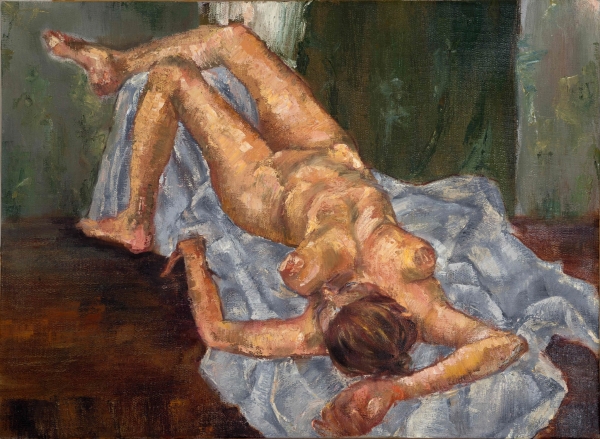
Elisheva Galperin – Solo Exhibition
Global Art Gallery
13 Merkaz Ba'alei Melakha, Tel Aviv
Curators:
Dr. Galia Duchin |
Michali Adler
In my art, I explore myth as a
universal human language. I am interested in images, narratives, and emotional
states that exist beyond time and culture, and that continue to resonate within
contemporary human experience.
A central idea in my practice is that of the lost paradise—not as a physical place, but as an inner state to which human beings continually aspire yet can never fully attain. The tension between desire, memory, longing, temptation, hope, and the impossibility of returning to the past becomes a
driving force in my work.
I turn to mythological themes and to myth as a way of speaking
simultaneously about personal and collective
experience. What draws me to myth is its ability to contain metaphor,
ambiguity, and multiple layers of meaning without becoming merely illustrative.
Myth allows me to work with universal emotional structures while leaving space
for uncertainty and interpretation. In my works, the human figure becomes the
bearer of an archetypal experience, while the relationships between figures
convey invisible psychological forces such as attraction, anticipation,
acceptance, conflict, and loss.
Composition forms the foundation of
my working process long before a detailed image emerges. I begin by exploring
relationships between forms, directions of movement, and visual tension. I am
interested in how emotional and psychological states can already exist within
the composition itself, before narrative or detail appears.
Often, one form becomes dominant
while another becomes receptive, creating a dynamic field of tension between
them. A sense of aspiration without final resolution is an essential part of my
work. My approach to composition is closely connected to a Baroque
understanding of form, in which individual elements function only as part of a
broader, interconnected structure rather than as isolated details. I strive to
create visual spaces in which every part depends upon the whole and cannot
fully exist apart from it. For me, therefore, the relationship between elements
is not decorative, but structural and emotional.
I work with a variety of materials
and techniques, including oil paint, pastel, pencil, paper, wood, and textured
surfaces. I am particularly drawn to natural materials and traditional methods
of working. My interest in historical techniques does not stem from nostalgia
or from a desire to recreate the past, but from a sense of the physical and
material continuity they carry within them.
I regard technique as a way of
thinking through material and surface. I rarely begin a work on a blank,
neutral surface. Layers of paint, textures, accumulated materials, and prepared
surfaces already contain a particular visual atmosphere before the image itself
emerges. These surfaces create an active environment within which the work can
develop organically. The material becomes a partner in the process rather than
merely a passive tool.
Unexpected textures, marks,
densities, and accidental changes in the surface can alter the direction of the
composition and influence the formation of the final image. This element of
unpredictability and uncertainty is an important part of my practice.
My works develop through several
stages of transformation: an initial idea, compositional sketches, an
exploration of form and material, variations, and the gradual crystallization
of the final image. I am interested in the process itself as a form of research,
in which the image evolves through an ongoing negotiation between intention and
discovery.
Through my work, I explore questions
of human longing, the relationship between memory and forward movement, and the
ways in which ancient mythological structures continue to shape contemporary
emotional experience. For me, turning toward the past is not an attempt to move
backward, but a search for a foundation from which to move forward.
Elisheva Galperin
Solo Exhibition | 10 November 2026 – 12 December 2026
Stories for you more +